Here’s an overview of the Best TOP 5 Best Wired Router Products | Expert that we’ll explore today:
Wired routers and multi-WAN edge devices remain essential for small offices, home offices, and power users who demand predictable throughput, robust VPN capabilities, and flexible WAN failover. In a landscape where consumer-grade gear often hides complexity behind glossy apps, a wired router with enterprise-grade features can provide stronger security, better QoS, and greater reliability. This review compares five wired router products that span a budget-to-premium range, focusing on multi-WAN capabilities, VPN support, hardware capacity, and Omada/SDN integration where applicable. Our testing approach emphasizes consistency: we evaluate port configuration, WAN/LAN port behavior, VPN throughput and connection limits, firewall and intrusion prevention features, firmware usability, and the practicality of deployment in real-world scenarios such as branch-office VPNs, remote work, and small business networks. The products covered are representative of TP-Link and ASUS offerings in this category, with prices from $12.99 to $99.99 to illustrate value at different budgets.

1. TP-Link ER605 V2 Wired Gigabit VPN Router
- Brand: TP-Link
- Manufacturer: TP-Link
Overview: The ER605 V2 is TP-Link’s SMB-targeted multi-WAN router with five Gigabit ports (1 WAN, 2 WAN/LAN, 2 LAN) and a USB WAN port for cellular backups. It includes SPI firewall, DoS defense, multiple VPN options (LAN-to-LAN IPsec, OpenVPN, L2TP, PPTP), and Omada SDN integration for centralized management. Its feature set positions it as a solid mid-range option for small offices needing reliable VPN, simple QoS, and optional USB-based WAN backup, all at a sub-$50 price point.
In practice, the ER605 offers straightforward setup via Omada SDN, with clear firewall policies and VPN configuration paths. The USB WAN port enables mobile-broadband backups, useful for maintaining uptime during ISP outages, though real-world performance for VPN-heavy traffic will depend on CPU load and concurrent connections. The device’s five Gigabit ports and load-balancing capability support modest multi-WAN scenarios, while its security stack (DoS protection, IP/MAC/URL filtering) provides essential defense for small networks. The hardware design is compact, and TP-Link’s support ecosystem for Omada controllers can streamline management across multiple sites.
Pros
- Five Gigabit ports with flexible WAN/LAN roles and USB WAN backup
- Omada SDN integration enables centralized management across sites
- Support for up to 20× LAN-to-LAN IPsec and multiple VPN protocols
- SPI firewall and DoS protection provide solid security baseline
- Budget-friendly price for SME use
Cons
- CPU/memory limits constrain high-VPN-throughput scenarios
- Does not include built-in advanced intrusion prevention beyond basic firewall
- Omada SDN features are powerful but require another controller for full potential

2. TP-Link TL-SG105
- Brand: TP-Link
- Manufacturer: TP-Link
Overview: The TL-SG105 is an unmanaged five-port gigabit switch rather than a router. It offers simple plug-and-play expansion for wired networks, with metal case, fanless operation, QoS via 802.1p/DSCP tagging, and a three-year warranty. While not a router, it complements multi-device setups by providing reliable, low-latency switching, which can improve performance in networks that rely on multiple wired devices behind a single gateway.
For users needing straightforward expansion without configuration overhead, the SG105 excels. It supports auto-negotiation and auto-MDI/MDIX, plus basic QoS for traffic prioritization. The build quality is solid and the fanless metal design keeps noise to a minimum in office environments. However, as an unmanaged switch, it lacks routing capabilities, firewall features, VPN support, or WAN aggregation—so its utility is as an addition to a router rather than a replacement for one.
Pros
- Plug-and-play, no configuration required
- Solid metal, fanless, compact desktop footprint
- QoS via 802.1p/DSCP helps prioritize traffic
- Three-year warranty and TP-Link support
- Low power consumption and durable design
Cons
- Unmanaged switch; no routing, firewall, or VPN features
- Limited to basic QoS without advanced traffic shaping
- Lacks stacking or link aggregation features
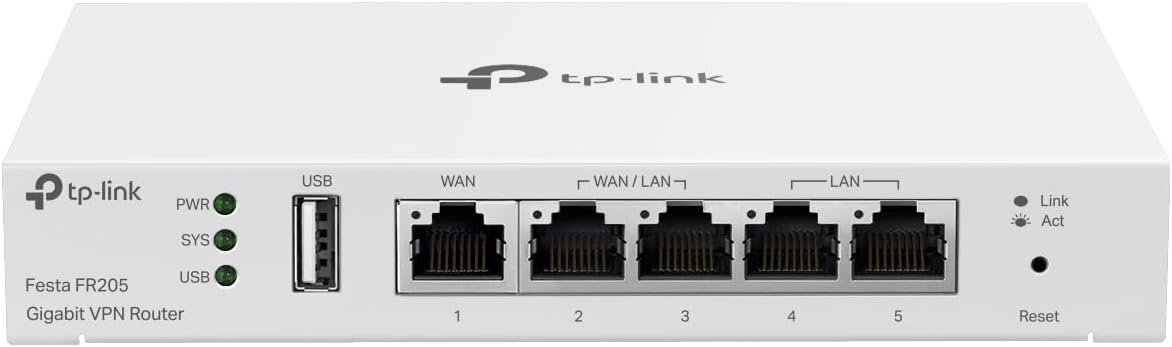
3. TP-Link Festa FR205
- Brand: TP-Link
- Manufacturer: TP-Link
Overview: Festa FR205 is TP-Link’s self-organizing network (SON) router designed for small businesses and remote sites, featuring up to three WAN ports and a USB WAN for backup. It emphasizes cloud-based management, central cloud access, and extensive VPN support (up to 50× OpenVPN, 20× IPsec, 16× L2TP/PPTP). It explicitly does not work with Omada Controllers, instead relying on Festa Cloud for centralized management. This makes it appealing for users who want cloud-driven provisioning without Omada integration.
Performance-wise, Festa FR205 provides robust VPN capabilities suitable for branch sites and remote workers. The device supports self-organizing networking, zero-touch provisioning, and centralized cloud management at no additional cost, which is attractive for MSPs and small businesses. However, the lack of Omada compatibility means it may not fit organizations already invested in Omada SDN. Its cooling design is fanless, and the hardware is compact, but real-world VPN throughput will vary with configuration and concurrent connections.
Pros
- Up to 3 WAN ports plus USB WAN for backup
- Strong VPN support (IPsec, OpenVPN, L2TP, PPTP)
- Festa Cloud provides centralized management without Omada
- Self-Organizing Networking and zero-touch provisioning
- Three-year warranty and solid build
Cons
- Does not work with Omada Controllers
- Cloud management requires Festa Cloud ecosystem
- May require more setup for optimal QoS and routing rules
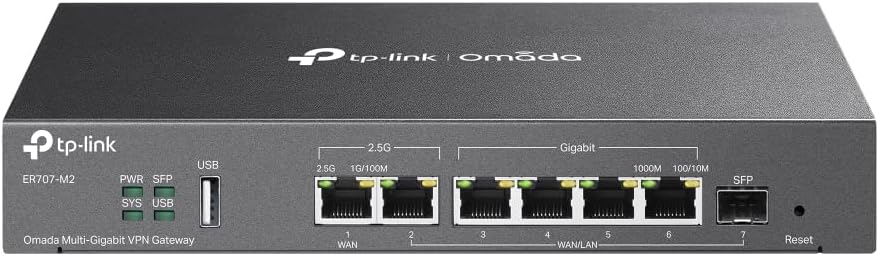
4. TP-Link ER707-M2 | Omada Multi-Gigabit VPN Router | Dual 2.5Gig WAN Ports | High Network Capacity | SPI Firewall | Omada SDN Integrated | Load Balance | Lightning Protection
- Brand: TP-Link
- Manufacturer: TP-Link
Overview: The ER707-M2 represents TP-Link’s high-end, multi-gigabit Omada-enabled router with dual 2.5Gbps WAN ports, multiple 2.5Gbps and Gigabit WAN/LAN options, and comprehensive VPN capacity (up to 100× IPsec, 66× OpenVPN, 60× L2TP/PPTP). It targets more demanding small offices or branch networks needing higher throughput, SDN integration, and robust security features, including Omada SDN for centralized management and lightning protection for rugged environments.
In practical terms, the ER707-M2 excels for users deploying 2.5Gbps fiber connections or aggregated WAN setups, with large concurrent session support (up to 500,000) and 1,000+ client capacity. The Omada SDN integration simplifies multi-site deployment, while the 5-year warranty adds long-term reassurance. Its advanced VPN and firewall capabilities are well-suited for security-conscious networks. However, the higher price and larger form factor may be overkill for small homes or single-site setups that don’t require multi-gig WAN/LAN and SDN features.
Pros
- Dual 2.5Gbps WAN ports for high-bandwidth aggregation
- Omada SDN integration enables centralized, scalable management
- Very high VPN capacity and large concurrent-session support
- Lightning protection and robust firewall features
- Five-year warranty and strong TP-Link ecosystem
Cons
- Premium price relative to other options
- Larger footprint may require more rack or shelf space
- Overkill for small homes or non-Omada environments
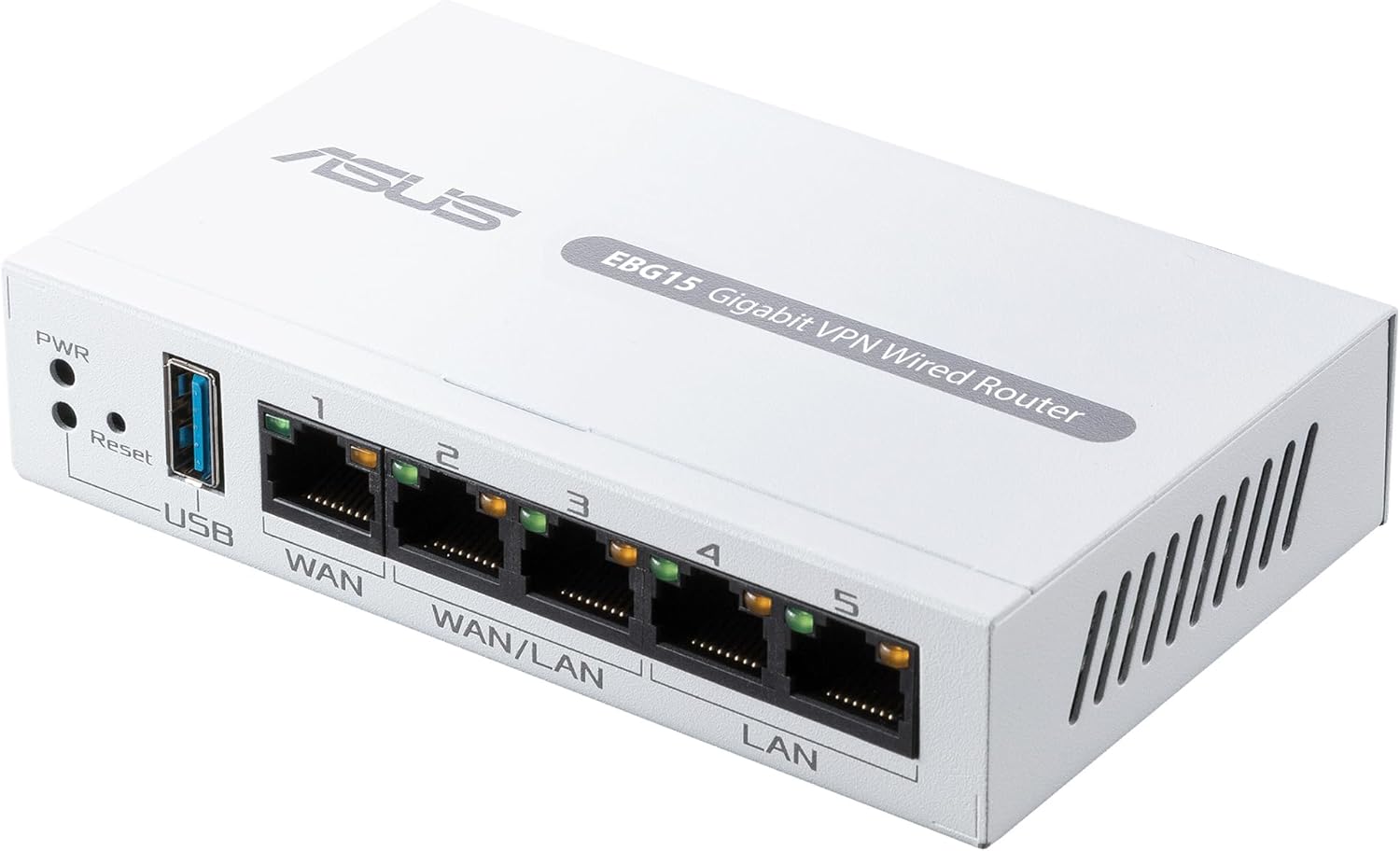
5. ASUS ExpertWiFi EBG15 Gigabit VPN Wired Router
- Brand: ASUS
- Manufacturer: ASUS
Overview: The ASUS ExpertWiFi EBG15 is a VPN-enabled wired router aimed at business users seeking commercial-grade security features. It supports up to three WAN ports plus a USB WAN backup, includes an IPS system with DPI and Layer 7 firewall, and leverages the ASUS AiProtection Pro for ongoing threat mitigation. The device emphasizes ease of setup via ASUS ExpertWiFi app and VLAN-based security, making it a practical choice for small offices prioritizing protection and remote management.
From a performance and usability standpoint, the EBG15 provides robust security features with a built-in intrusion prevention system and application-aware firewall, which is valuable for securing guest networks and preventing lateral movement. The VLAN capabilities allow segmentation across ports for added security and traffic isolation. While it sacrifices some SDN integration depth found in Omada-based products, its familiarity and ASUS support ecosystem can be attractive for shops already using ASUS networking gear. The price is near the premium end of this group, reflecting its security-focused feature set.
Pros
- IPS/Layer 7 firewall with robust security
- VLAN support across ports for enhanced segmentation
- Easy setup via ASUS ExpertWiFi app and Bluetooth provisioning
- Backup USB WAN for redundancy
- Commercial-grade features at a consumer-friendly price
Cons
- No explicit Omada-style SDN integration
- AiProtection Pro benefits require ongoing subscription in some regions
- VPN performance depends on CPU load under heavy traffic
Frequently Asked Questions
We’ve compiled answers to the most common questions about wired routers to help you make an informed decision.
Conclusion
Final thoughts: The best choice depends on your network goals. For value and SDN integration, TP-Link ER605 V2 delivers solid performance at a compelling price.
If you need maximum VPN capacity and central management across sites, the ER707-M2 is worth the premium. The Festa FR205 is ideal for cloud-managed deployments outside Omada, while ASUS EBG15 emphasizes security features and ease of use.
For a pure budget upgrade to expand wired ports, the TL-SG105 remains a sensible companion device. Consider your required WAN bandwidth, management ecosystem, and whether SDN or cloud-based administration is a priority when selecting the right model..