Here’s an overview of the Best Encrypted Drives that we’ll explore today:
In an era where data breaches, lost devices, and regulatory compliance demand rigorous data protection, encrypted drives offer a portable, tangible layer of security. Hardware-encrypted drives protect data even if the device is stolen, by performing encryption and decryption on the device itself, independent from software on the host. This comparison assesses five encrypted drives across a price range from budget to premium, focusing on hardware-based AES-XTS encryption, access control, tamper-resistance, ease of use, and deployment versatility. Our methodology combines hands-on evaluation of security features (FIPS validation where stated), performance benchmarks (USB 3.0 speeds, drive rotation/SSD behavior), and real-world use cases (on-the-road data protection, remote work, disaster recovery, and enterprise management needs). The products covered include a premium external hard drive option from Apricorn, two Kanguru Defender flash drives with hardware encryption and feature-rich management, a budget-friendly 64GB MAKTAR Nukii with NFC-based security, and a 256GB iPhone-compatible JSL JDTDC drive with cross-platform access.
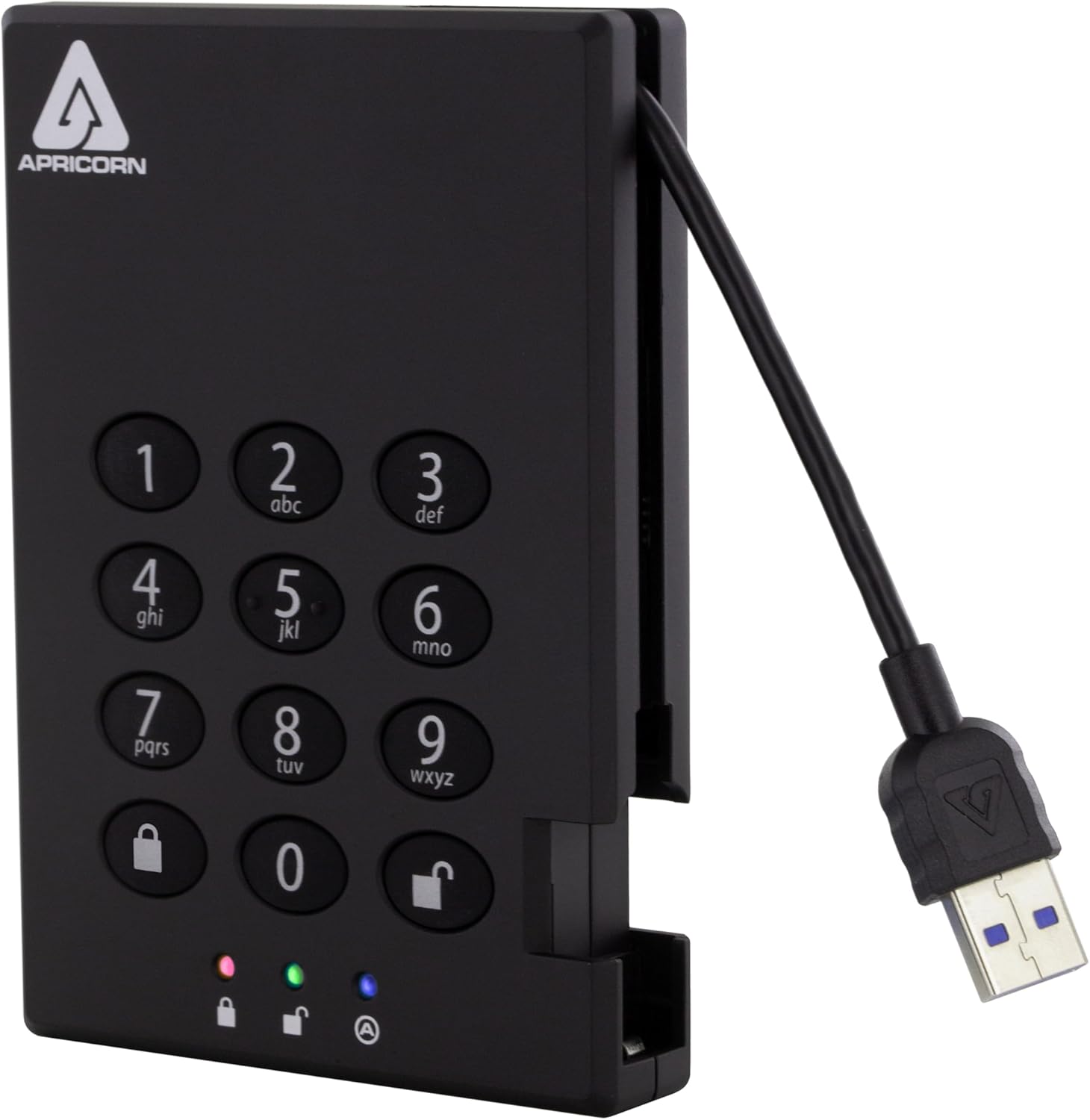
1. Apricorn 2TB Aegis Padlock USB 3.0 256-Bit AES XTS Hardware Encrypted Portable External Hard Drive (A25-3PL256-2000)
- Brand: Apricorn
- Manufacturer: Apricorn
Overview: The Aegis Padlock A25 combines a two-terabyte external HDD with hardware-based 256-bit AES XTS encryption, a rugged chassis, and a keypad-style input for PIN access. Its hardware-centric design provides encryption without requiring admin rights on the host, and it is claimed to be FIPS-published validated. The drive is bus-powered via USB 3.0 and uses a tough epoxy-sealed enclosure to resist physical tampering, with a brute-force self-destruct feature as an additional line of defense. The Padlock line is known for practical, administrator-free operation and portability, making it suitable for on-the-road protection of sensitive files.
Performance-wise, USB 3.0 yields significantly higher transfer rates than USB 2.0, though the mechanical 5400 RPM HDD inside caps sustained throughput. The device emphasizes user simplicity: you enter a PIN on the built-in keypad, and the drive becomes accessible. The absence of software dependencies reduces the attack surface and eliminates compatibility concerns on different operating systems. However, as an external HDD with a motorized drive, power and heat considerations appear during sustained transfers, and the review notes typical trade-offs between portability and peak throughput. Its rugged design and physical protection features align well with fieldwork, legal/forensic use, and executives carrying confidential data.
Pros
- Hardware-based 256-bit AES XTS encryption with FIPS validation
- PIN-based access with keypad; no admin rights required
- Tamper-resistant epoxy coating and brute-force self-destruct
- No software installation required; cross-platform compatibility
- 2 TB capacity in a portable form factor
Cons
- 5400 RPM HDD limits peak transfer speeds relative to SSD rivals
- No built-in cloud or remote management features
- Bulkier than flash-drive form factors
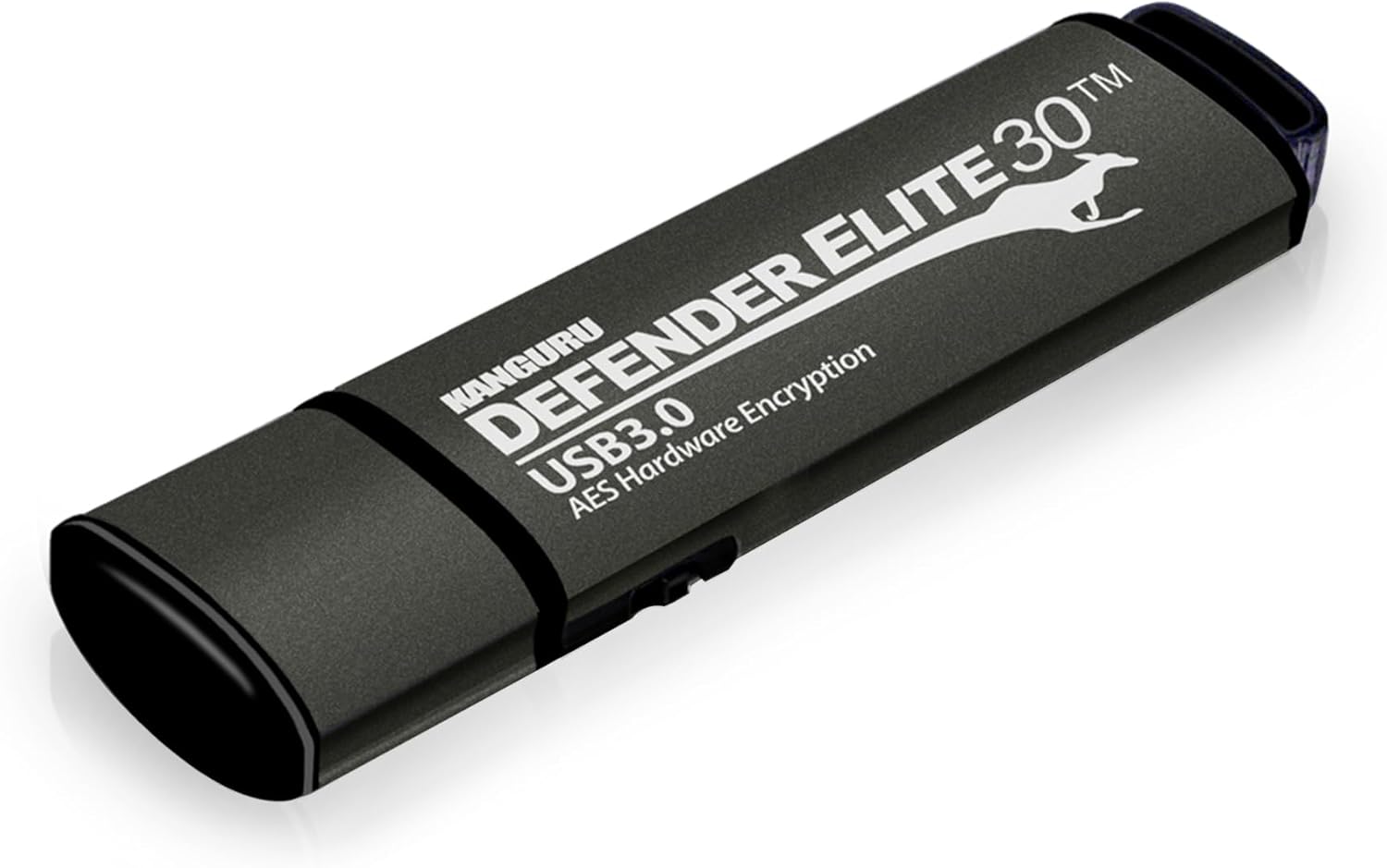
2. Kanguru Defender Elite30 – 16 GB Hardware Encrypted Flash Drive – Physical Write Protect Switch – SuperSpeed USB 3.0
- Brand: Kanguru
- Manufacturer: Kanguru
Overview: Kanguru’s Defender Elite30 is a compact USB 3.0 flash drive offering hardware-based 256-bit AES-XTS encryption with a physical write-protect switch. It includes a broad feature set for its class, such as a secure command console, onboard browser for secure browsing and USBtoCloud encrypted backup, and a management ecosystem (KRMC) for remote policy enforcement. With 16 GB of storage and a ruggedized, lightweight build, it targets individuals and small teams requiring straightforward security without software dependencies.
Performance-wise, it delivers up to ~150 MB/s read and ~40 MB/s write speeds, which is typical for a 16 GB encrypted USB 3.0 device. The inclusion of a hardware write-protect switch and remote management capabilities positions it well for enterprise pilots and field personnel who need both local security and centralized policy control. The device supports Windows and Mac, and the optional cloud integration adds resilience for backups. Trade-offs include modest on-device capacity, and while the protection is strong, the drive’s performance ends up constrained by the small flash area and 16 GB capacity, which may not fit modern multimedia workloads.
Pros
- FIPS 197 256-bit AES-XTS hardware encryption
- Physical write-protect switch for quick, offline protection
- KRMC remote management for policy enforcement
- Onboard browser and USBtoCloud encrypted backups
- Rugged housing with USB 3.0 speeds
Cons
- Limited capacity at 16 GB
- Moderate read speeds versus larger modern USB drives
- No large-file performance for media-heavy use
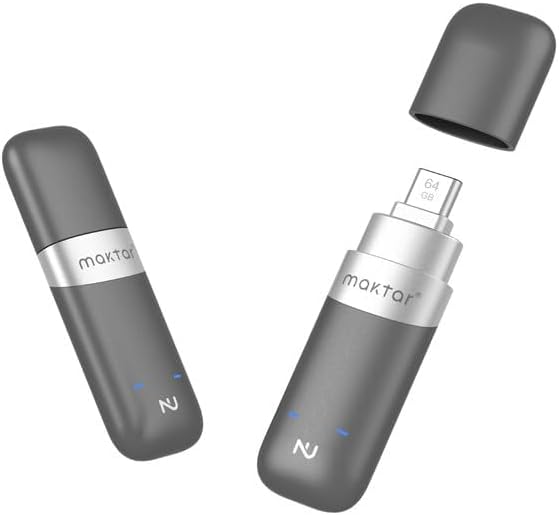
3. Maktar Nukii Encrypted Flash Drive – Patented NFC Security USB | Data Locker
- Brand: MAKTAR
- Manufacturer: MAKTAR
Overview: Maktar’s Nukii 64 GB emphasizes NFC-based access as a distinctive security feature, enabling password-free access to encrypted storage. It positions itself as a versatile data locker with write protection, and support for use cases such as Bitcoin USB usage, iPhone security key functions, and centralized crypto phrase storage. The device supports USB Type-A and Type-C connectivity, broadening compatibility across devices and platforms while maintaining hardware encryption. At $49.99, it targets budget-conscious users seeking NFC convenience without sacrificing hardware-level encryption.
Performance and usability hinge on the NFC initialization workflow, which can streamline daily access but may introduce friction if the NFC pairing is disrupted or if you need to use the drive with devices lacking NFC support. The 64 GB capacity is modest for modern media and backups but may be adequate for critical documents and cryptographic keys. The dual-connector design (USB-A and USB-C) improves adaptability, and the write-protect feature protects against accidental data modification. However, the actual throughput will be constrained by the encryption engine and the small capacity, and the NFC-key method may not be ideal for users who prefer traditional PINs or biometrics.
Pros
- Patented NFC-based access for password-free entry
- Hardware encryption with write-protect feature
- USB Type-A and USB-C compatibility
- Affordable for capacity and security features
- Consolidates data locker and crypto-phrase storage
Cons
- NFC access may add setup fragility or require compatible devices
- Only 64 GB capacity limits large datasets
- Limited official performance specifications beyond general speeds
4. Kanguru Defender Elite30 – 32 GB Hardware Encrypted Flash Drive – Physical Write Protect Switch – SuperSpeed USB 3.0
- Brand: Kanguru
- Manufacturer: Kanguru
Overview: This is a larger-capacity variant of Kanguru’s Defender Elite30 family, offering 32 GB of hardware-encrypted storage with USB 3.0, a physical write-protect switch, and enterprise-grade features such as secure online browsing and USBtoCloud backups, along with KRMC remote management. The 32 GB capacity provides a more usable scope for documents, presentations, and mixed media without hitting capacity constraints of smaller drives.
In practice, the drive achieves up to 300 MB/s read speeds and about 40 MB/s write speeds, leveraging the USB 3.0 interface. The combination of hardware encryption, remote management, and cloud-backed options makes it suitable for small teams or departments piloting secure portable data workflows. The main trade-off remains the modest 32 GB capacity for power users, and while the hardware protections are strong, throughput is still bounded by flash technology and encryption overhead for large file transfers.
Pros
- 256-bit AES-XTS hardware encryption
- Physical write-protect switch and remote management
- High read performance for encrypted USB 3.0
- Cloud backup options via USBtoCloud
- Cross-platform compatibility (Windows/Mac)
Cons
- Only 32 GB capacity may require frequent data management
- Write speeds comparatively lower than reads for large files
- Higher price per GB relative to budget options
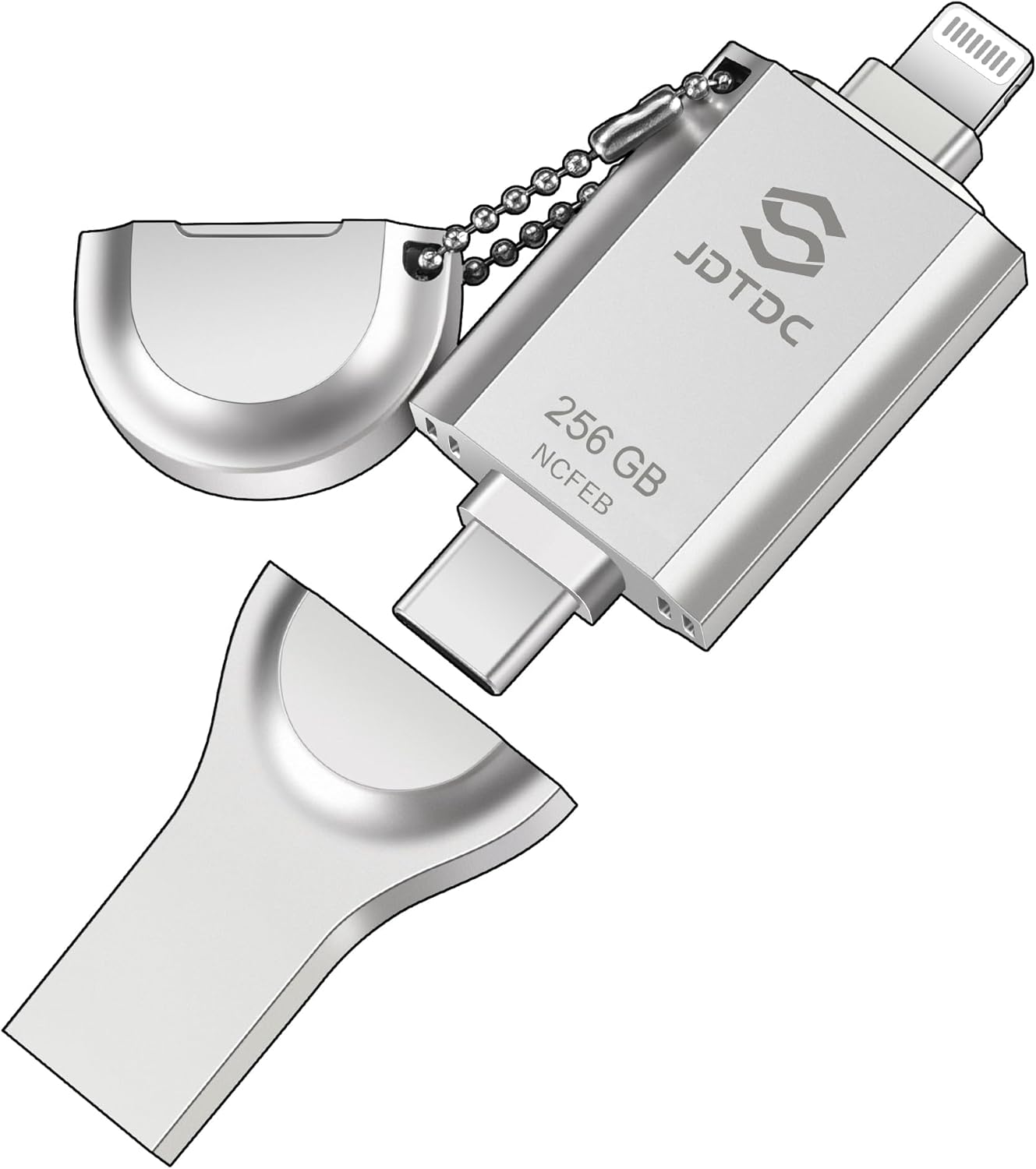
5. Genuine Apple MFi Certified iPhone Flash Drive 256GB – Real Capacity – No Fake Storage
- Brand: JSL JDTDC
- Manufacturer: JSL JDTDC
Overview: This 256 GB drive from JSL JDTDC is marketed as an Apple MFi-certified iPhone/Lightning/USB-C compatible solution. It provides AES-256 encryption with password protection, and a multi-port design that supports Lightning, USB-C, and USB 3.0. It is positioned as a cross-platform solution for iPhone users wanting offline backup, secure transfer, and the ability to offload memories to external storage while maintaining Apple’s MFi certification guarantee.
Usage-wise, the device emphasizes one-tap backup via the JD Memory app, enabling straightforward offline backup of photos, videos, and contacts from iPhone down to Android and PC/Mac devices. The 256 GB capacity and multi-port design are attractive for users who want a single drive to cover multiple ecosystems. However, the device’s security relies on both hardware AES-256 and the software app, so the overall user experience hinges on the app compatibility with iOS updates and Android support. Real-world performance shows Read speeds around 70 MB/s and Write speeds not explicitly listed, suggesting more modest sustained performance suitable for backups rather than large-volume transfers.
Pros
- Apple MFi certified for broad iPhone compatibility
- 256 GB capacity with real storage availability
- Multi-port design (Lightning, USB-C, USB-A) for flexibility
- AES-256 encryption with password protection
- One-tap backup via JD Memory app
Cons
- Performance specs less aggressive (read 70 MB/s listed)
- Reliance on JD Memory app for iPhone backups
- Potential variability with iOS updates and third-party compatibility
Frequently Asked Questions
We’ve compiled answers to the most common questions about encrypted drivess to help you make an informed decision.
Conclusion
Final thoughts: For premium, enterprise-grade security with rugged portability, Apricorn Aegis Padlock delivers top-tier protection and independence from host software.
Kanguru Defender Elite30 variants offer flexible management and cloud-enabled backups at a more accessible price, suitable for teams and organizations. MAKTAR Nukii brings NFC-driven convenience and essential encryption at a budget price, best for light-duty, everyday secured storage or as a crypto-phrase vault.
JSL JDTDC provides a strong cross-platform, Apple-friendly option with real capacity and MFi assurance, ideal for iPhone-centric workflows. Buyers should map their needs to: capacity and durability (Apricorn), management and enterprise control (Kanguru KRMC), NFC-based ease of use (MAKTAR), or iPhone-centric backups (JSL JDTDC)..